
In 2026 ELMED stopped being a long-announced project and became a construction programme. The converter stations and the submarine cable are awarded, a national steering committee is in place, the EBRD has opened procurement for the onshore 400 kV line, and on 2 November the guarantee for its financing went to Parliament under urgent procedure. Here is where the Tunisia–Italy interconnector stands, and what it opens.
2026, the year ELMED moved into execution
The milestones have come in quick succession:
- January: the Head of Government called for the pace of delivery to be stepped up, with regular progress reviews. On 15 January Tunisia and the EBRD signed a EUR 43 million financing for ELMED 2, the reinforcement of the Tunisian grid that will carry the link’s power.
- April: the Secretary of State for the Energy Transition announced that almost all execution contracts had been signed and that works would start in 2026.
- June: Terna and STEG awarded Hitachi Energy a contract of about EUR 770 million for the two HVDC converter stations, at Partanna in Sicily and Mlaabi, in the Menzel Temime area of Cap Bon. Prysmian, for its part, received the notice to proceed on a cable contract of about EUR 460 million.
- September: the ELMED steering committee held its first meeting on 22 September, chaired by the minister in charge of energy and bringing together the ministries concerned and customs. The next day, the EBRD published the general procurement notice for ELMED 2.
- November: on 2 November the Bureau of the Assembly sent bill no. 66 of 2026, approving the guarantee for the EBRD loan, to the Finance and Budget Committee and asked for urgent handling.
The link in figures
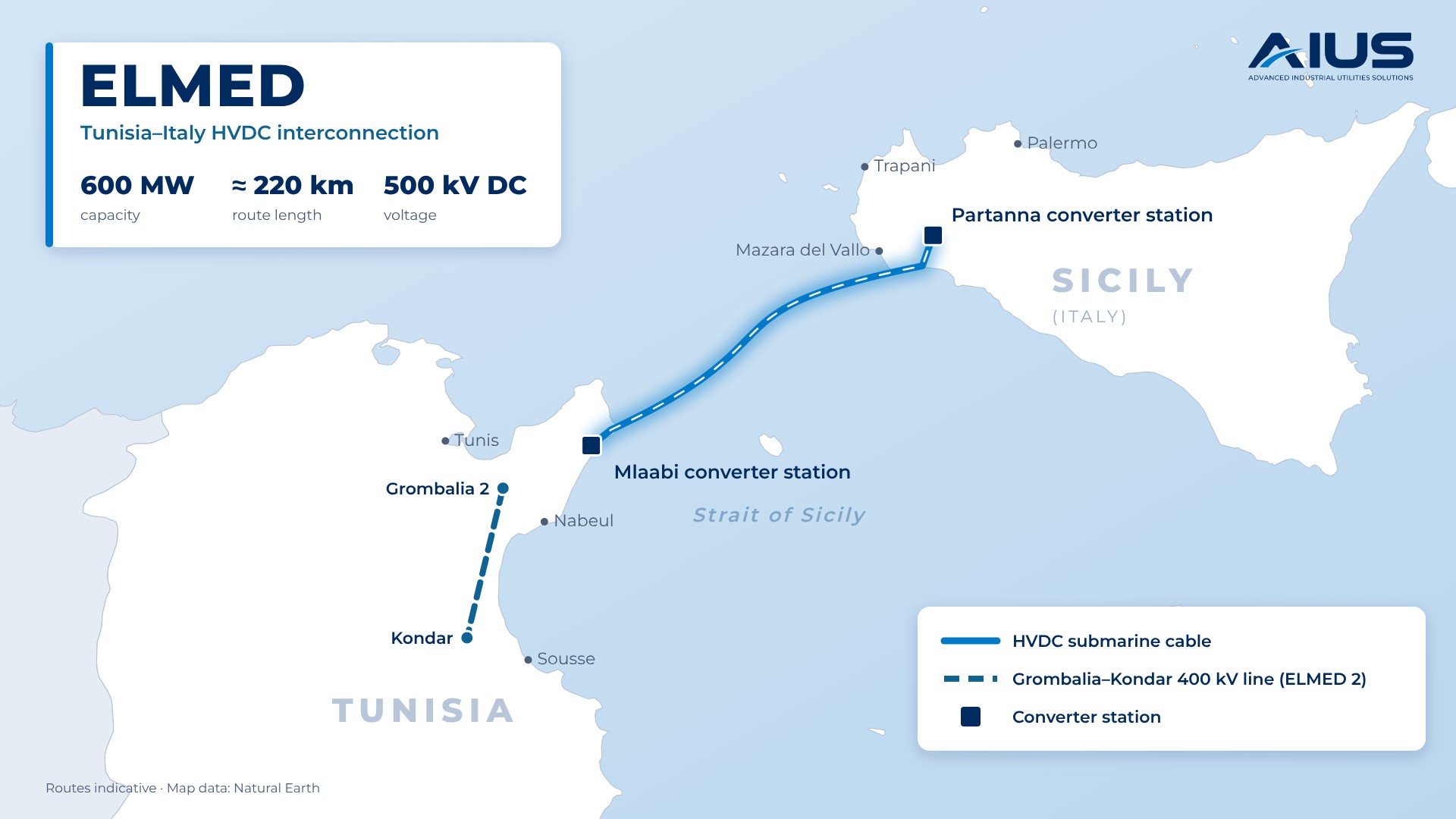
ELMED will carry 600 MW in both directions over about 220 km, nearly 200 km of it submarine cable across the Strait of Sicily, at up to 500 kV DC and in water up to 800 m deep. It will be the first direct-current interconnection between Europe and North Africa.
Hitachi Energy supplies the full HVDC system: converter valves, its MACH digital control platform, power transformers and high-voltage switchgear. Civil works, electromechanical installation and auxiliary systems at Mlaabi go to Orascom Construction, and at Partanna to D’Agostino Costruzioni Generali. The cable is manufactured at Prysmian’s Arco Felice plant near Naples and will be laid by its own fleet.
The total budget is now reported at about EUR 1.42 billion, and the two main contracts alone account for more than four-fifths of it. The financing stack is broad: a EUR 307.6 million grant from the EU’s Connecting Europe Facility, USD 268.4 million from the World Bank for the Tunisian converter station and internal grid works, EUR 125 million of loans from the EBRD, EIB and KfW signed in December 2023, EU grants for implementation support, and now the EBRD’s EUR 43 million for ELMED 2. Commissioning is announced on a 2028 to 2030 horizon.
The Tunisian grid gets its own upgrade
A 600 MW converter station on Cap Bon is only as useful as the grid behind it, and STEG is reinforcing that grid in parallel. ELMED 2 centres on an 85 km, 400 kV overhead line between the Grombalia 2 substation in Nabeul and Kondar in the governorate of Sousse, crossing Nabeul, Ben Arous, Zaghouan and Sousse. Two sets of entry and exit lines, Ezzahra–Grombalia 1 and Seltene–Grombalia 1, about 10 km each, tie it into the 400/225 kV Grombalia 2 substation: roughly 105 km of new 400 kV circuits in all.
The EBRD loan runs for 18 years, including a five-year grace period. Its purpose is to strengthen the transmission backbone, carry power produced mainly in the south and centre towards the north and Cap Bon, and prepare the network for renewable output and exports to Europe. Procurement goes through the EBRD’s ECEPP platform and is open to firms from all countries.
What ELMED opens for Tunisia
- An outlet for renewables: Tunisia targets 35% renewable electricity by 2030. A 600 MW link to the Italian and European system gives solar and wind projects a larger market and gives the grid a buffer to absorb variable output.
- Security of supply: the link works both ways. During summer peaks, imports from Italy can relieve a system under pressure.
- Work for contractors and suppliers: civil works at Mlaabi, 400 kV lines through four governorates, connection works and the services around them will draw on local subcontractors, engineering firms and suppliers for several years.
- A market framework to build: EU-funded technical assistance is helping prepare the rules for operating and commercialising the interconnector. Players who follow that work closely will be the first ready to use it.
With its main contracts awarded and its financing in place, ELMED now has a clear path to the Strait of Sicily. The coming months will be about the land: the lines, the substations and the rules that turn 600 MW of capacity into an opportunity for Tunisia’s energy sector.
AIUS works as a local technical partner to international developers, investors, integrators and EPC contractors in Tunisia and North Africa, and provides technical advisory, due diligence, development and financial close support, project management and construction supervision through to commissioning, as well as bid management. If you are looking at the opportunities around ELMED, we are available to discuss them.
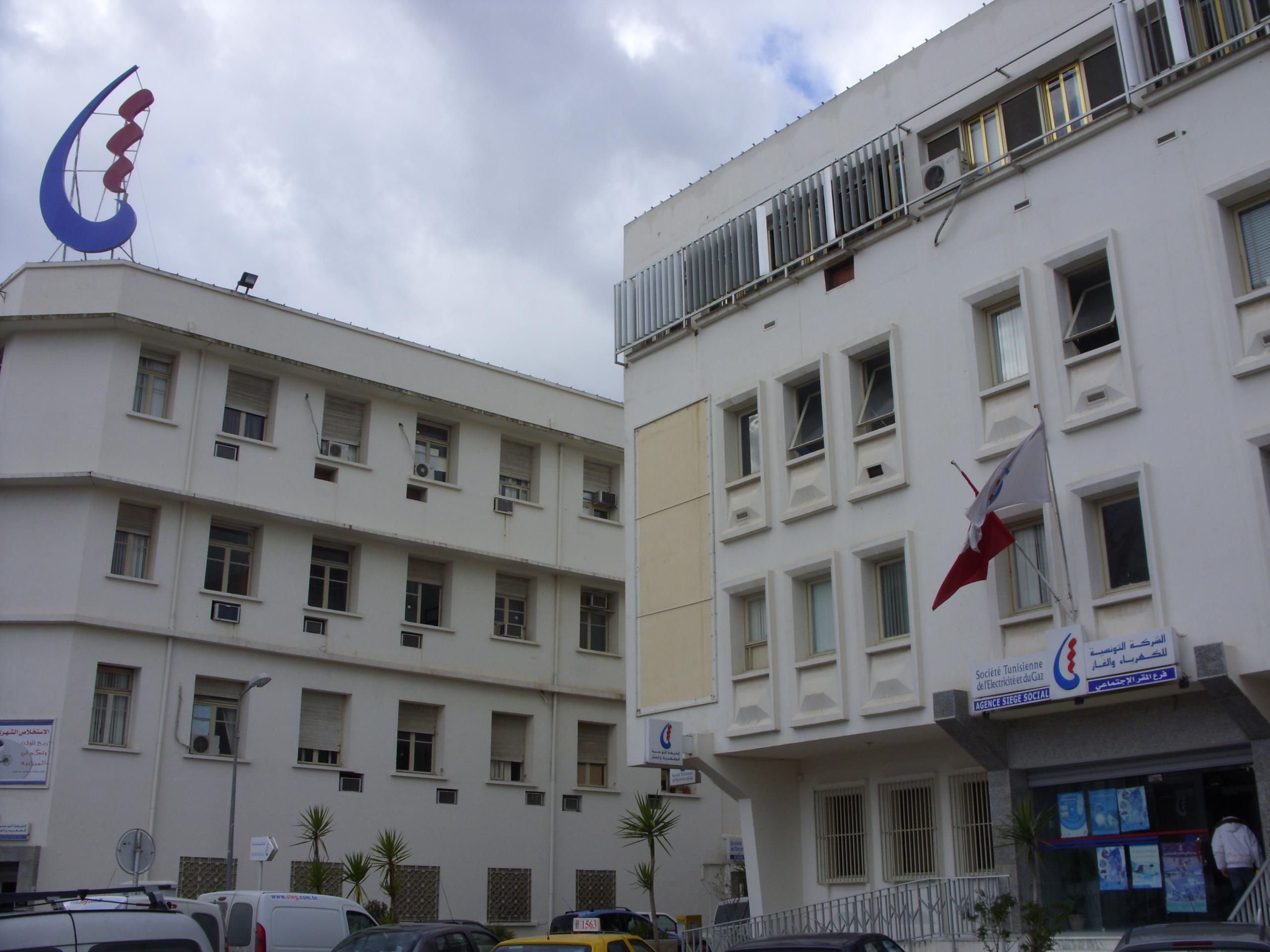
Map: AIUS (Natural Earth data). Photo: STEG headquarters, Tunis