

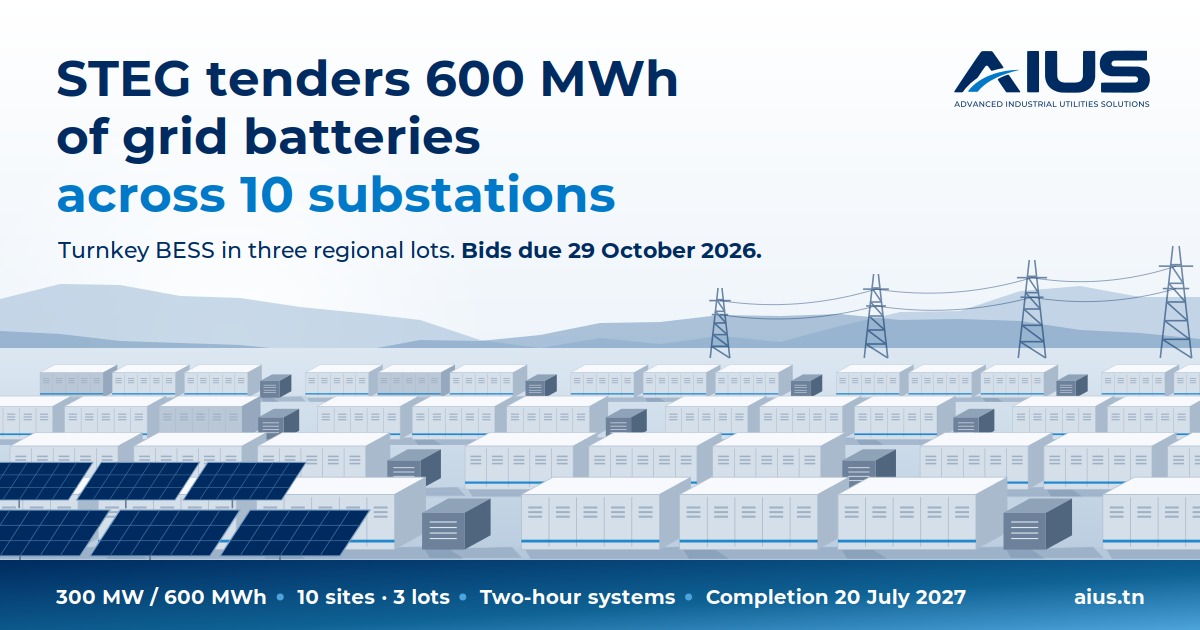
On 24 September 2026, STEG published international tender AOI 2026 E 4017 for the turnkey delivery of battery energy storage systems at ten sites on its network: 300 MW / 600 MWh in total, split into three regional lots. The scope covers design, supply, installation, commissioning and maintenance, to international standards of performance, safety and cybersecurity. Bids are due on 29 October 2026.
It is the first utility-owned storage programme of this size in Tunisia, and it arrives only weeks after the Bazma solar-plus-storage concession. The two could hardly be more different, and the differences say a good deal about how the country intends to use batteries.
Key terms
| Buyer | STEG, Direction Centrale de l’Equipement |
| References | AOI 2026 E 4017 · TUNEPS 20260901938 |
| Procedure | Open international tender, foreign-currency portion possible, consortia allowed |
| Contract | Turnkey, lump sum |
| Funding | STEG own funds |
| Award criterion | Lowest compliant price |
| Bid deadline | 29 October 2026 — 09:00 per the tender notice, 09:30 per TUNEPS |
| Bid opening | 29 October 2026, 10:00, public session, Tunis |
| Bid validity | 120 days |
| Execution | 210 days, completion 20 July 2027 |
Ten sites, three lots
All ten systems connect to STEG medium-voltage substations.
| Lot | Site | Power | Energy |
|---|---|---|---|
| 1 — Nord | Ben Arous | 15 MW | 30 MWh |
| Gaafour | 37.5 MW | 75 MWh | |
| Mateur | 15 MW | 30 MWh | |
| Kchabta | 37.5 MW | 75 MWh | |
| 2 — Centre | Msaken | 30 MW | 60 MWh |
| Ksour Essef | 30 MW | 60 MWh | |
| Bir Lahfey | 30 MW | 60 MWh | |
| 3 — Sud | Gabès Sud | 30 MW | 60 MWh |
| Médenine | 37.5 MW | 75 MWh | |
| Midoun | 37.5 MW | 75 MWh | |
| Total | 300 MW | 600 MWh | |
Provisional bid bonds are TND 1.20 million for Lot 1, TND 1.08 million for Lot 2 and TND 1.32 million for Lot 3 — TND 3.6 million for a bidder going after all three.
Every site is a two-hour system
The most telling detail is the one that repeats. Each of the ten sites has an energy-to-power ratio of exactly two hours. That is a choice about what the batteries are for.
A two-hour system sized in tens of megawatts is built for power: covering an evening peak, relieving a loaded substation, supporting voltage and frequency, absorbing midday solar and returning it a few hours later. It is not a bulk energy-shifting asset. Compare Bazma, where the concession pairs 300 MW of solar with 150 MW / 540 MWh of storage — 3.6 hours at a single site — to move a large solar plant’s output into the evening.
The public notice does not state the operating regime, and the technical specification will. But the configuration points clearly towards network support rather than energy trading.
Distributed, and where solar is arriving
Ten medium-voltage connection points is a very different engineering task from one large plant. Each site has its own civil works, its own interface with an existing substation and its own protection and control integration.
The location list is worth reading alongside the sixth authorisation round. Bir Lahfey sits in Sidi Bouzid, the governorate with the largest capacity retained in Round 6, and Médenine and Gabès were also among the most concentrated. Distributed solar connects at medium voltage. Placing two-hour storage on those substations is consistent with managing the midday surplus that hundreds of small plants will create — though STEG has not said so, and the reading should be treated as inference.
Utility-owned, own funds, lowest price
Unlike Bazma, there is no concession, no private sponsor and no lender. STEG buys the assets outright from its own resources, and the contract follows Tunisian public procurement rules rather than the procurement guidelines of an international financier.
The award goes to the lowest compliant price. For batteries, that places the whole question of value on the specification. Capital cost is only part of what a buyer pays for: degradation, round-trip efficiency, availability guarantees, capacity augmentation and the maintenance obligation determine what the system is worth over its life. Bidders should price the full maintenance scope with care, since it is inside the contract, and read the performance guarantees in the specification closely, because under a lowest-price award that is where compliance will be tested.
The calendar is the real constraint
A 210-day execution period ending on 20 July 2027 implies work starting around 22 December 2026. That leaves roughly 54 days after bid opening for evaluation, award and contract signature. Any slippage in evaluation comes straight out of the construction window, because the end date is fixed.
The date itself is no accident. It places the batteries in service for the summer 2027 peak — the same target as the third gas turbine at Borj El Amri, and for the same reason: peak demand has been rising sharply, reaching 6,400 MW in July 2026. Containerised battery systems are not usually the long-lead items in such a programme. Medium-voltage transformers, switchgear and power conversion equipment can be, and ten parallel sites multiply every interface.
Practical points for bidders
Work to 09:00 on 29 October: the tender notice and TUNEPS disagree by half an hour, and the earlier time is the safe one. Bidders must be registered on TUNEPS with a valid electronic signature certificate; a firm not yet registered should start now rather than in the final week. Any part of the bid submitted offline must physically reach STEG’s central registry by the deadline — postmarks do not count. Site visits can be requested from STEG in advance, through the contact given in the notice. And TUNEPS carries a record of deadline changes for this tender, which is worth checking before final submission.
Sources
STEG, Appel d’Offres International N° 2026 E 4017 — Réalisation clés en main des systèmes de stockage d’énergie par batteries multi-sites (Projet BESS), tender notice, and STEG tender page published 25 September 2026. TUNEPS, tender record 20260901938, published 24 September 2026. Execution start date calculated by AIUS from the published execution period and completion date.
AIUS works as local technical partner to international integrators and EPC contractors bidding in Tunisia — on TUNEPS submission, site and substation interfaces, STEG connection requirements and local execution — and provides project management and construction supervision through to commissioning. If you are preparing a bid for this tender, we are available to discuss it.